
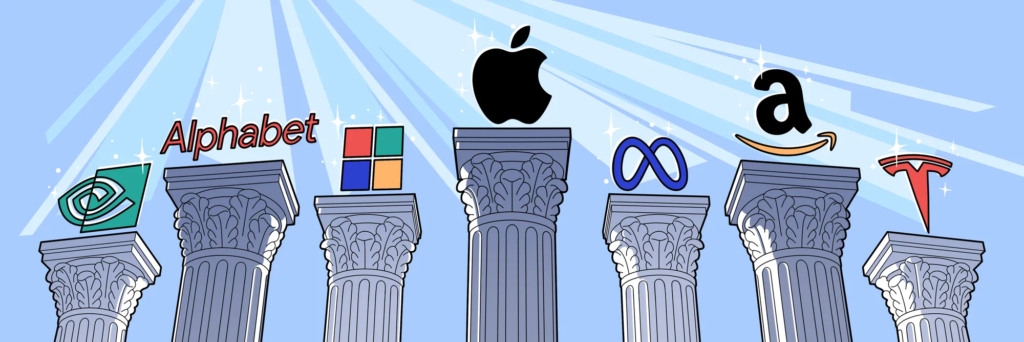

Who Are the Magnificent 7?
The Magnificent Seven is a group of seven mega-cap companies that are among the most influential forces in financial markets, collectively and individually. “The Magnificent Seven are no longer just ‘tech stocks,’” said Marcel Miu, CFA, CFP, founder of Simplify Wealth Planning. “They have become the gravitational center of the modern economy.”
These companies include:
Alphabet (GOOG/GOOGL): Google’s parent company and a global leader in search, digital advertising, cloud computing, and artificial intelligence (AI).
Amazon (AMZN): One of the world’s largest ecommerce companies and a global leader in cloud computing and media streaming.
Apple (AAPL): Globally dominant technology company specializing in consumer hardware and services.
Meta Platforms (META): Owner of leading social platforms like Facebook, Instagram, and WhatsApp, and a pioneer in augmented and virtual reality.
Microsoft (MSFT): One of the world’s biggest providers of computer software, hardware, and cloud services, whose platforms underpin modern business.
Nvidia (NVDA): Tech powerhouse and leading developer of graphics processing units (GPUs), which are crucial for advanced computing in areas like AI.
Tesla (TSLA): Leader in automotive tech and clean energy, known for popularizing electric and autonomous vehicles.
The Magnificent Seven achieved such lofty market positions primarily through their ownership of key digital platforms and technological infrastructure.
“Whether it’s cloud computing, social networks, AI chips, ecommerce, or mobile ecosystems, each company controls a massive part of modern life,” said Dr. Steven Crane, ChFC, founder of Financial Legacy Builders.
This platform dominance has allowed the Magnificent Seven to scale globally and amass immense cash reserves. As a result, they can continually invest in next-generation innovations, such as AI, helping them stay ahead of the competition.
“While AI is the current thematic driver pushing their valuations higher, the underlying engine is their massive cash piles and platform moats,” said Miu. “They have the capital to buy or build the future, which makes them resilient.”
Why These Stocks Matter So Much
Major stock market indices, like the S&P 500 and Nasdaq-100, are weighted by market capitalization. This means the biggest companies have the most influence on each underlying index’s performance.
The Magnificent Seven stocks have grown so big that they drive a disproportionate share of these indices’ returns—and those of the funds that track them. In other words, they’re often largely responsible for market rallies and corrections.
“These seven stocks now comprise roughly 30% of the S&P 500,” said Miu.
“This creates a ‘tail wags the dog’ scenario. If the Magnificent Seven drops by 10%, the entire index takes a significant hit even if the other 493 companies stay flat.”
Strategy Considerations
Before investing in the Magnificent Seven, take stock of your existing exposure, especially through potentially opaque holdings like target-date funds.
“Many people do not realize they already own the Magnificent Seven through their retirement accounts,” said Crane. “Adding even more on top of that can create concentration you never intended.”
It’s also important to revisit your exposure regularly. If the Magnificent Seven outperform your other investments, they may grow to represent more of your portfolio than you intended. Rebalancing can help you avoid this risk and maintain your desired asset allocation.
“Buying a passive index fund is actually a form of momentum investing,” said Miu. “You are automatically buying more of the companies that have already won. To maintain diversification, investors might need to take an active approach by paring back these winners or buying equal-weighted funds to balance out their exposure.”
How Much of the S&P 500 Do the Magnificent 7 Represent?
As of October 2025, the Magnificent Seven stocks represented roughly 37.4% of the S&P 500 index’s market capitalization. Their size gives these companies a disproportionate influence on the index’s performance.
1
Can I Invest in the Magnificent 7 Through a Single ETF?
Many broad-based index funds, sector ETFs, and thematic ETFs hold positions in each of the Magnificent Seven stocks. For example, funds that track the S&P 500 or Nasdaq-100 are heavily weighted toward these companies, making them a convenient way to gain exposure.
What Are the Risks of Owning Only the Magnificent 7?
The biggest risk is overconcentration. If you only own the Magnificent Seven, a setback for any one of them could meaningfully affect your returns. Additionally, these stocks may react similarly to factors that affect the tech sector. Any negative trends could drive underperformance or losses from multiple factors simultaneously.
The Bottom Line
The Magnificent Seven control much of the world’s most important infrastructure. As a result, they’ve grown exceptionally large and gained disproportionate influence over major stock market indices, like the S&P 500.
This makes them potentially attractive investment opportunities, but it also increases the risk of overconcentration. If you’re going to invest in these companies directly or through broad funds, strategic diversification and regular rebalancing are essential.